
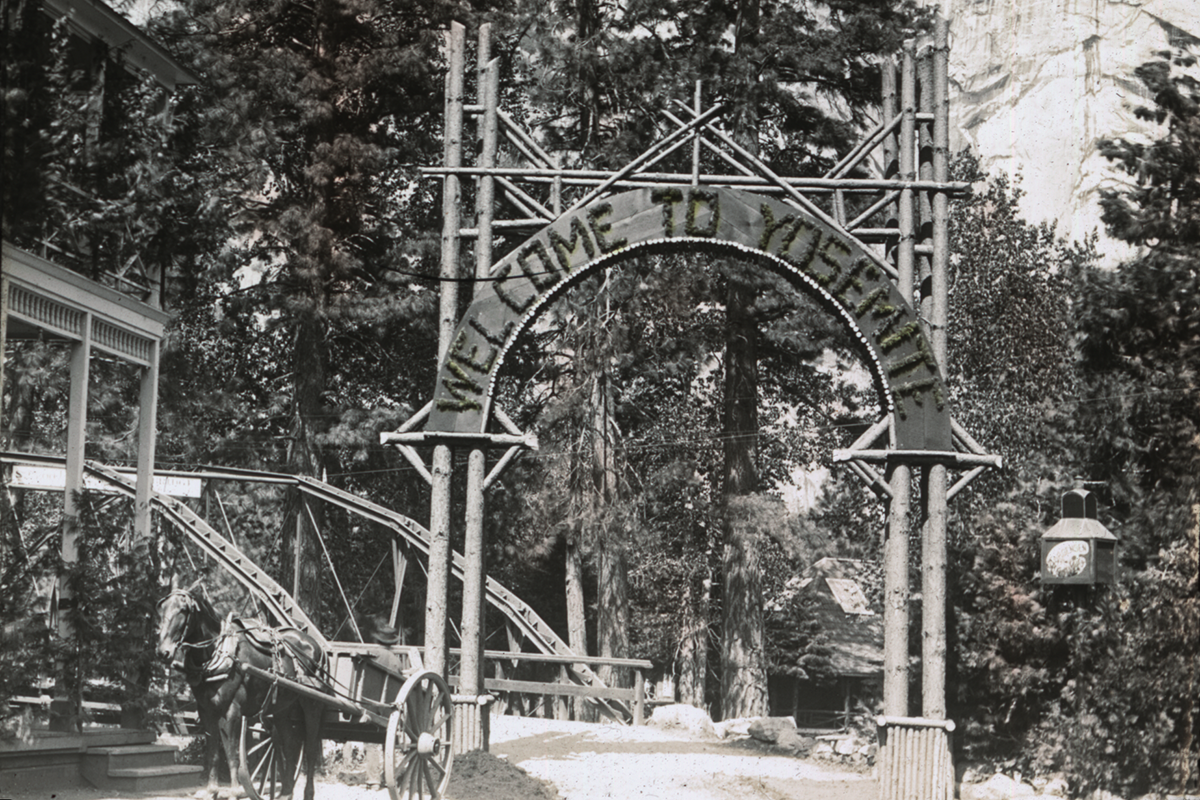
The Camping Trip That Changed America

The trip that launched America’s conservation movement took place in Yosemite on May 15, 1903, when President Theodore Roosevelt spent three nights and four days exploring Yosemite Valley with the legendary naturalist John Muir.
Roosevelt left behind his White House entourage and rode into the valley with Muir, both of whom were looking for a little respite from their respective political burdens.
The two men were both avid wilderness lovers, yet they presented a study in contrasts, perhaps best seen in their sleeping arrangements, as Muir, ever the ascetic, opted for his customary humble bed of pine boughs under the stars while Roosevelt snoozed in a more sumptuous set up – a pile of 40 wool blankets under a shelter-half.
Yet, despite their differences, this meeting of the minds helped launch the American conservation movement, create National Monuments and establish the tradition of presidents preserving millions of acres of wilderness.
Into the Wilderness

On the first night, the two men camped underneath the Grizzly Giant, one of the most prodigious sequoia trees in Yosemite’s famed Mariposa Grove. Roosevelt was tired and after a dinner of “fried chicken and beefsteak” the party bedded down for the night in preparation for their excursion.
Though hardly a pure backpacking trip according to contemporary standards, the two men moved camp every day, taking down and setting up camp, even if Muir famously eschewed a tent.
On the second day, the two men rode horses up to Sentinel Dome, which affords one of the most expansive views of the spectacular granite-rimmed valley. On the final day, they essayed back into the valley and made camp near Bridalveil Falls.
Roosevelt at the Crossroads

The trip came at a pivotal moment for both men, as Roosevelt was relatively early into his first term as President. He was initially tapped as William McKinley’s vice-president because his own party wanted to sideline him due to his reformist tendencies. When President McKinley was assassinated in 1901, Roosevelt, an ardent admirer of American wilderness, was actually on a hiking trip.
He was in the middle of ascending Mount Marcy, the highest mountain in the Adirondacks and the highest peak in New York State, when a messenger intercepted him at Lake Tear of the Cloud, the source of the Hudson River, to tell him McKinley would likely perish of his gunshot wound.
So Roosevelt threaded through the Adirondacks along 10 miles of rough trails before finally reaching a horse-drawn wagon that carried him to Buffalo, where he arrived in his muddy hiking clothes to take the oath and become President. It is remembered as “The Ride to the Presidency.”
Thus, Roosevelt’s presidency began in the wilderness, on a hike.
It’s easy to look back and assume Roosevelt’s status as one of the great presidents was a shoo-in, but he was 42 years old when he was sworn in, by far the youngest president in history up to that point. Roosevelt was a Republican and was viewed unfavorably by Democrats, particularly when it came to his ambitious foreign policy including the annexation of the Panama Canal. He was also mistrusted by his Republican colleagues, who did not like his anti-monopoly approach to taming big business. When he met with John Muir in Yosemite a couple of years into his first term, he was at a political crossroads, disliked or mistrusted by both sides.
Muir’s Uphill Battle

Muir was at a crossroads, himself. While he was 20 years older than Roosevelt at the time, he had spent the last decade in the conservation fight.
He co-founded the Sierra Club in 1892, and despite legislative victories, including the establishment of Yosemite National Park and Yellowstone National Park, he’d spent the last decade watching his beloved Sierra Nevada steadily ravaged by timber companies.
He’d tried to get Lake Tahoe declared a national park, and failed and then watched the forest surrounding the lake decimated to provide the timber for the gold mines in California foothills and the silver mines of Northern Nevada.
He’d recently fallen out with his friend and ally Gifford Pinchot over the contentious issue of allowing sheep-grazing operations to persist in the Sierra.
He was considered a bit zany by Roosevelt’s advisors, who argued that the American wilderness was so vast that timber and other resource extraction operations wouldn’t dent the vast store of natural resources.
Initially, Muir was leery of the camping trip altogether, having entertained countless politicians on similar forays into the Yosemite wilderness, only to see them vote against him at the 11th hour. But Roosevelt, who was President after all, had written him a personal letter.
“I do not want anyone with me but you, and I want to drop politics absolutely for four days and just be out in the open with you,” Roosevelt wrote to Muir in 1903.
Muir agreed to meet with Roosevelt, who he knew as the Rough Rider who’d hiked his way to the Presidency and had bought a ranch in Medora, North Dakota and avidly expressed an appreciation for the wildlands of the American West that paralleled Muir’s own.
Meeting of Minds

So Muir boarded a train from San Francisco, with a robust delegation of California officials, including the governor and the president of the University of California, and met the president in Mariposa Grove. After some photo op preliminaries, the president dismissed everybody except for Muir, two guides named Archie Leonard and Charles Leidig and a U.S. Army packer named Jacker Alder.
Leidig, the camp cook, later provided the only first-person account of the excursion, which is by turns insightful and downright funny, particularly when he portrays Muir and Roosevelt bickering with each other over whose turn it is to talk. Both were great talkers, of course.
On the second day, Yosemite received a surprise late spring snowstorm and Muir and Roosevelt took turns breaking trail on horseback through five feet of fresh snow before reaching their intended camp near Sentinel Dome. At Leidig’s recommendation they moved their camp to a meadow behind Glacier Point, where water was more plentiful.
Roosevelt and Muir spent that night talking about the need for federal conservation of the American wilderness, Muir’s glacial theory of the Yosemite Valley (a theory that was hotly contested by more credentialed geologists like Josiah Whitney and which, of course, has since been proven correct), “the setting aside of other areas in the United States for park purposes” and the need for forest conservation.
“I stuffed him pretty well regarding the timber thieves, the destructive work of the lumberman, and other spoilers of the forest,” Muir wrote in a letter to an ally.
The third day of the trip was somewhat marred by the crowds of onlookers vying to get a glimpse of Roosevelt after they descended to the valley. But after hiding out for a spell in Curry Village, the group managed to set up camp near Bridalveil Falls, where Roosevelt regaled the men about his recent lion-hunting trips in Africa. After breakfast the next morning, Roosevelt and Muir climbed into a stagecoach together and parted later that day as friends.
Natural Persuasion

Leidig’s account is rich in capturing the kind of petty bickering that often attends extended wilderness trips, including Roosevelt’s growing annoyance with Muir, who persistently picked pine twigs to place in the President’s buttonholes.
Regardless of these minor squabbles, it is evident that a bond was formed and Muir ultimately proved persuasive during their expedition.
Roosevelt went on to establish 230 million acres of public lands during his two-term presidency, including 150 national forests (comprising three quarters of all national forests), the first 55 federal bird and game reserves, 5 national parks and 18 national monuments. Additionally, he established a major precedent in signing the Antiquities Act of 1906, which gave the President executive authority to establish national monuments out of federal lands to protect, natural, cultural or scientific resources.
It has been used by nearly all of the presidents since, with President Barack Obama creating 29 such monuments (the most ever) during his term, including a flurry in the final days of his second term.
Thus, those three days in May, where five men engaged in the familiar outdoor ritual of passionately sharing their perspective around a campfire, changed the entire trajectory of American conservation, providing a template for protecting wilderness throughout the world and cementing a national park system that novelist Wallace Stegner called “the best idea we ever had.”
Recreating the Pilgrimage Today

Modern adventures looking to retrace the Roosevelt-Muir route, perhaps a pilgrimage of sorts, will encounter complexity in the form of park regulations and a lack of trail continuity through time, but the trip can be approximated.
It is a mix of car camping and backpacking, requiring some logistics management and preplanning, but the trip offered below provides a glimpse into this important historical moment and an excellent introduction to the wonder of Yosemite Valley.
All backcountry camping requires a wilderness permit, so plan ahead. Public transport via free shuttle and bus connect the ends of the route.
Day 1: Mariposa Grove & Wawona → Empire Meadows

Begin at Mariposa Grove, home to the Grizzly Giant. Spend a night or two at Wawona Campground, near where Roosevelt stayed in the Victorian Wawona Hotel before meeting Muir. The hotel is currently closed but worth a visit nonetheless. Start at the trailhead for Alder Creek and follow it until the branch towards Deer Camp. Continue north on Deer Camp Road into Empire Meadows and camp where the Roosevelt-Muir party had lunch on the first day (9.5 mi).
Day 2: Empire Meadows → McGurk Meadow

Pack up camp at Empire Meadows and continue north on Deer Camp Road past Bridalveil Meadows, where the party plowed through 5 feet of snow, to the Westfall Meadow Trailhead. Cross Glacier Point Road here and continue just past McGurk Meadow to camp one mile from the road (6.0 mi).
Day 3: Pohono Trail → Glacier Point → Panorama Trail → Little Yosemite Valley

Continue on the McGurk Meadow Trail to the Pohono Trail and follow it east along the rim to Glacier Point and recreate the famous Roosevelt–Muir photo. From there, descend the Panorama Trail past Illilouette Fall to the top of the Nevada Fall. From there, proceed about a mile upstream along the Merced River to camp at the Little Yosemite Valley backpacker campground, the only legal option in this zone and where the party had lunch on the second day (14.0 mi). McGurk to Little Yosemite is a big day and can be broken up by taking the Buena Vista Trail to camp near the junction with the Mono Meadow Trail. Alternatively, you could hike all the way into the valley on the Four Mile Trail, but it’s an aggressive downhill trek. Trekking poles are highly recommended for the long downhill.
Day 4: Mist Trail → Yosemite Valley

If you overnight at the Little Yosemite Valley campground, retrace your steps to the top of Nevada Fall. Just like Roosevelt and Muir, opt to descend via the Mist Trail, passing the bottom of Nevada Fall and Vernal Fall, two of Yosemite’s most iconic sights. The trail is steep, wet, and often crowded, so an early start is advantageous. End in Yosemite Valley at Happy Isles (4.2 mi). If you want to recreate the final night of camping in the valley, book a site at North Pines, Lower Pines, or Upper Pines Campground. Camp 4, nearer to Bridalveil Falls is another option, though its walk-in sites typically fill early each morning.
Logistics: Valley shuttles connect Happy Isles, Four Mile Trailhead, and Lower Pines Campground to Yosemite Village. The free YARTS Highway 41 Bus can take you from Yosemite Village to Wawona and you can park at either endpoint.
Gear for the Modern Adventurer
Muir may have slept on pine boughs under the stars, but for most of us, a tent is essential, especially since surprise snowstorms still sweep through Yosemite in late spring and early fall. If you’re in the market, see our Tent Rankings, where we analytically compare backpacking tents by weight, performance, and value.
What This Journey Gives You
The advantage of this itinerary is clear: you get a whirlwind tour of Yosemite Valley while walking in the footsteps of Roosevelt and Muir, recreating what may well be the most consequential camping trip in American history.
Stay Wild and Wander Well!


Leave a Reply