
Introduction

Pitching a tent is straightforward, until it’s not.
Setting up a tent on a calm evening with perfect ground conditions is not a particularly difficult task, especially as manufacturers have made their products more user-friendly. But once you get into the backcountry, conditions have a way of tossing curveballs at the worst possible moment – at the end of a strenuous hike, when your strength, attention and patience are all severely taxed.
I’ve been there.
When I backpacked the Santa Cruz Trek in the Cordillera Blanca region of the Peruvian Andes, I made the mistake of pitching a freestanding tent without staking it down and was forced to sprint at full speed down the mountainside to rescue it as it tumbled pell-mell down the steep slope toward a mountain cataract that would’ve whisked it away had I not seized it at the streambank. When I camped near Consultation Lake on the way to summit Mt. Whitney, I was confronted with rock-hard ground that defied all attempts to drive a tent stake into the ground. I once pitched a tent on the shore of Thumb Cove just outside Seward, Alaska only to awake in the middle of the night to find my campshoes and other belongings floating around me inside the tent. The tide had come in while I slept (who knew that Alaska is subject to the highest tidal fluctuations in North America outside of the Bay of Fundy). Even recently as I was camping with my two boys in the Redwood forest just outside of Monterey when a sudden rainstorm hit, making it challenging to set up while keeping the interior of the tent and the rest of our gear dry.
Let my mistakes be your lantern (or headlamp, as it were).
This guide will walk you through the techniques that separate confident campers from those who spend miserable nights in poorly pitched shelters. Whether you’re dealing with howling winds, unforgiving ground, or Mother Nature’s other challenges, you’ll learn how to create secure, comfortable shelter no matter the conditions. This guide will also help you make informed purchasing decisions, so the shelter you buy is either optimized for specific conditions or is versatile enough to adapt to different backcountry scenarios.
Before The Pitch

The most important tent setup skill isn’t about poles or stakes or instructional efficiency—it’s learning to read your immediate environment like a map. All too frequently campers rush into setup without taking five minutes to really look around, only to spend hours fighting preventable problems.
Site selection isn’t exactly detective work, but it’s instrumental to a comfortable night. Watch how the wind moves through the trees or how clouds are tracking across the sky. Look for the subtle clues that tell you where water flows or pools when it rains, or which areas stay protected when winds pick up. Check for flatness and anything sharp in the area. Sometimes the difference between a great campsite and a miserable one is just a few steps in any direction.
Your gear matters too, but not just the obvious stuff. Consider bringing backup items like a couple more stakes than your tent requires, or paracord for when guylines break. Think about small tools to aid in setting up: a small rock hammer for stubborn ground, and maybe a lightweight shovel that can serve double duty in snow or for digging drainage channels (it can provide important waste management functions as well).
Tilting at the Wind

Wind is probably the most common tent setup challenge you’ll face, and it’s definitely one that can go from annoying to dangerous pretty quickly. Along with almost losing my tent in Peru, I’ve learned this lesson countless times as a weary backpacker just trying to get my tent to cooperate at the end of a hard day.
The key to wind success starts with finding the right spot. You want protection, but not the kind that comes with risks. Camping downwind behind a steadfast boulder? Ideal. Camping directly under a rickety tree that’s been shedding branches? Less than. Look for natural windbreaks like hills, dense vegetation, or rock formations that provide shelter without introducing danger.
When you’re ready to start setup, organize everything and weigh it down before you begin. Lay out your components in logical piles, but put a rock, your pack, or something heavy on everything, like your tent body, your rainfly, your stake bag. In high winds, if it can blow away, it probably will. I once watched my friend chase his tent pole bag down a scree field because he skipped this simple step.
Work progressively into the wind rather than trying to set up your whole tent at once. Start with your windward corner and get that anchored solidly before moving to the next point. Build from a secure base and expand outward.
When staking down guy lines in the wind, drive those stakes at an angle, about 30 to 45 degrees away from the tent. This creates a system that resists stake pull out. And don’t be shy about adding extra guy lines to every attachment point your tent offers.
The manufacturer’s basic setup often assumes perfect conditions, which is a luxury often unavailable in the wild.
In really serious wind, consider dropping your tent profile. Some tents allow you to shorten pole segments or pitch lower than the standard setup. You’ll sacrifice some interior space, but you’ll gain stability that might make the difference between sleeping and spending the night holding your shelter together.
If you know that you’ll be camping in a high-wind situation such as above treeline in the mountains, consider purchasing options that prioritize stability over interior space. Think short, stout and overbuilt rather than tall and airy. A low-profile dome with multiple guy-out points will outperform a spacious cabin tent when you’re camping on wind-driven ridges. Angled rather than vertical walls can help deflect the wind without taking too much load. Also think about tent designs that bend but don’t break; tunnel tents, popular in northern Europe, are known for this.
Getting Stoned

Hard-packed, rocky terrain will humble even experienced campers, but it doesn’t have to defeat you. The trick is expanding your definition of what counts as an anchor point. Most backpackers assume that stakes go into the ground and that’s that. That assumption can lead to some frustrating evenings and a few bent stakes.
Your first line of defense is making stake holes where you can. This isn’t about brute force—it’s about patience and technique. Start with something small like the awl on your multi-tool or even a car key to create a pilot hole. Then gradually work it bigger. A splash of water can soften hard-packed earth enough to make the difference. And yes, it takes time, but it’s still more convenient than dealing with a poorly anchored tent in the middle of the night.
When stakes simply won’t work, it’s time to get creative with rock anchors. Build small cairns over a rock wrapped with the end of your guy lines, using rocks that interlock and support each other. The key is making sure your bottom rocks are solid and your guy line is trapped securely without sharp edges that might abrade or even cut it.
Sometimes the landscape gives you natural anchor points that actually perform better than stakes. A solid tree root, substantial log branch, or established boulder can often handle way more force than any stake you’re carrying. Just make sure you’re not damaging vegetation and that your anchor point isn’t going anywhere.
For ground comfort and to protect the floor of your tent on rocky terrain, spend the extra time to clear your tent footprint properly. You don’t need to remove every pebble, but getting rid of anything that might puncture your floor or create an uncomfortable lump under your sleeping pad is worth the effort. And always use a footprint or ground sheet in rocky conditions—your tent floor will thank you.
When selecting gear for rocky terrain, look for tents with sturdy floor and footprint fabrics, durable stake loops, and a freestanding design to minimize staking requirements. If you’re going ultralight, just know that some trade-offs—including low denier fabric and lack of a footprint—make adapting to rocky terrain more difficult. Ultralight is a great way to go, but it makes ideal site selection that much more imperative.
Winter Gauntlet

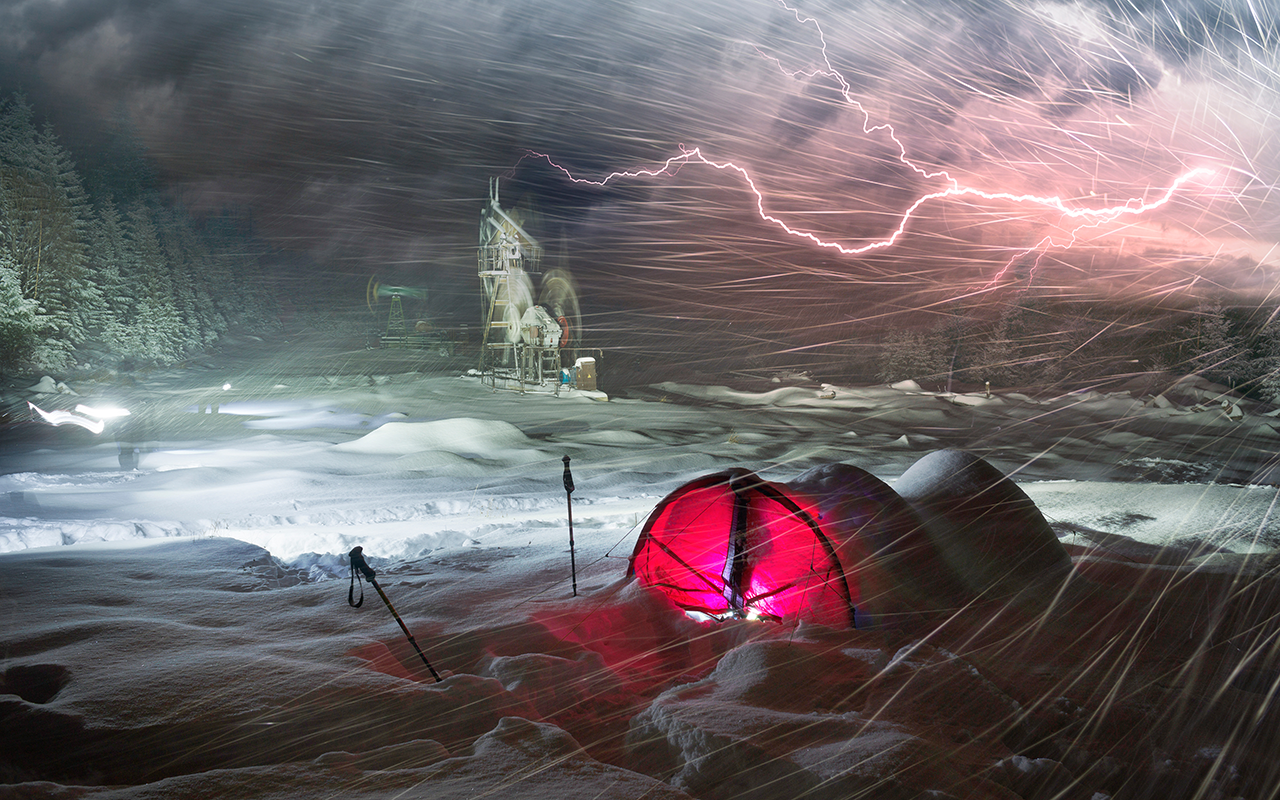
Snow camping feels like camping in a completely different world, because in many ways, it is. Everything you know about anchoring gets turned upside down, the ground that you’re standing on has fallen from the sky, and the environment itself becomes both your tool and your challenge.
Start by creating your own campsite through snow modification. Trample down the area where your tent will go. Really pack it down. Walk back and forth over it, jump on it, whatever it takes to compress the snow into a solid platform.
If you have a shovel (and in snow camping, you should), create a flat platform that’s bigger than your tent footprint. This gives you room to work and ensures your tent edges aren’t hanging over loose snow. Build low walls on the windward side if you can. They don’t need to be elaborate, just enough to break the wind and catch blowing snow.
In snow, your anchors go horizontal and get buried. The deadman anchor is your best friend here. Take a stuff sack, fill it with snow, attach your guy line, and bury the whole thing about 12-18 inches deep. The snow you pack around it sets up like concrete, creating an incredibly strong anchor point.
You can also use your skis, snowshoes, shovel, or even spare tent poles as deadman anchors. Bury them horizontally in a T-shape to the guy line direction, pack snow around them, and give it time to set up, which depends on snow conditions.
Condensation management becomes critical in snow camping. All that moisture from your breathing and body heat has to go somewhere, and if your tent isn’t ventilated properly, it’s going to freeze on the inside walls. Keep some ventilation open even in cold conditions, and regularly brush ice crystals off the tent walls before they build up too much.
Snow camping requires a four-season tent with heavier fabric, stronger poles and tighter rainfly coverage. Look for full-coverage rainfly protection against spindrifts, adequate ventilation options to manage condensation (usually protected hoods), and generous vestibule space for gear storage and cooking. Bright colors are easier to spot during whiteouts.
O The Dreadful Wind and Rain

Setting up in rain is all about speed, organization, and keeping your priorities straight. Your goal isn’t a perfect setup, it’s getting functional shelter quickly and then improving it once you’re protected.
If you can see rain coming, beat it to the punch. There’s no camping law that says you have to wait until you reach your planned campsite if weather is moving in. Sometimes the best campsite is simply the one you can reach before the deluge starts.
When you must set up in the rain, and your shelter allows it, consider the rainfly-first approach. Get your rainfly up with minimal stakes, just enough to create a protected workspace underneath. You can use a hiking pole as a temporary prop to provide room to operate. Then assemble the rest of your tent in relative dryness. This takes practice to do smoothly, especially if wind is a factor, but it’s a game-changer when you’re stuck in the rain.
Site selection becomes crucial when rain is involved. You’re looking for ground that won’t become a lake. Even slight slopes help, and you want to think about where water will flow when it hits the ground. That innocent-looking flat spot might be perfect in dry conditions but turn into a pond when rain starts.
Consider creating drainage around your tent if you expect significant rain. I wish I had done this when I was forced to weather out a two-day storm beneath Mt. Mckinley (Denali). Eventually I used my boot heel to dig small channels around my tent to keep it dry, but I would have saved myself considerable hassle and wet clothes had I done so preemptively. Small channels scraped in the dirt around your tent’s perimeter can divert water away from your shelter. It only takes a few minutes and can make the difference between staying dry and waking up in a puddle.
Desert Heat

Desert camping reverses nearly everything about tent setup timing and priorities. The sun becomes your enemy during setup, capable of making tent materials too hot to handle comfortably and turning the setup process into a trial against heat exhaustion. Natural shade from canyon walls, boulders, or sparse trees is premium real estate, cutting radiant heat on your body and tent materials.
If you’re arriving at your campsite during the heat of the day, seriously consider waiting. Find or create some shade and take a siesta until temperatures drop. Your tent setup will go smoother, you’ll be more comfortable, and your gear will last longer. Desert veterans often set up camp around sunset and break camp during the pre-dawn hours when temperatures are coolest and winds are typically calm. Adventuring starts at first light to take advantage of the coolest light of the day.
When you do set up in heat, work smart. Wear long sleeves and a hat—counterintuitive maybe, but your skin will thank you. Keep your tent components in shade as much as possible during setup. Hot tent fabric and dark anodized poles can literally burn your skin, and overheated materials become harder to work with.
Daytime ventilation is a top priority. Select your site with breeze patterns in mind and set up your tent to maximize airflow options. Some will opt to dispense with the rainfly in clear weather, but consider using it during the day for UV shielding and thermal management. The air gap between the fly and tent body creates crucial insulation from the sun’s heat.
For desert camping, pay attention to ventilation systems when purchasing, and opt for light colors like tan, beige, or light gray that repel heat better than dark or bright options. Double doors are crucial for cross ventilation, which makes a massive difference in desert conditions.
High Country Challenges

High altitude camping is like regular camping with the difficulty turned up across the board. The air is thinner, which means you’ll be a bit more tired during setup. Weather changes happen faster and more dramatically. And UV exposure is significantly more intense, affecting both you and your gear.
Plan for everything to take longer at altitude. Your body is working harder just to function normally, so don’t rush the setup process. Take breaks if you need them, stay hydrated, and pay attention to how you’re feeling. Altitude can mess with your judgment, so double-check your setup decisions and err on the side of overbuilding.
Weather at altitude changes with startling speed. You might start setup in calm, clear conditions and find yourself dealing with wind and weather within minutes. Set up for the worst conditions you might reasonably encounter, not the conditions you’re currently experiencing. This is pretty much a rule of thumb across the board, but particularly important at high altitude.
The UV exposure at altitude is considerable. Your tent materials are taking a beating from the increased UV, so consider set up timing and positioning to take advantage of available shade to minimize unnecessary exposure.
For high-altitude camping, invest in tents with quality footprints, generous vestibule space for cooking and gear management during weather changes, and UV-resistant fabrics that withstand intense sun exposure. Quick-setup features like color-coded poles become valuable when altitude affects your energy and judgment.
Soggy Ground

Most of the time, experienced campers will strive to avoid camping in soggy, boggy ground no matter the cost. But sometimes, whether you are camping in Iceland, on a scientific expedition to perma-frost regions in the Arctic, or more simply conditions forces your hand, you’ll need some techniques for surviving in these less than ideal conditions.
Marshy, boggy ground presents a unique challenge because normal anchoring techniques simply don’t work. Stakes pull out, heavy deadman anchors sink, and sometimes the ground itself can’t support the weight of your tent and gear.
Start by testing the ground with your trekking poles or a stick to understand what you’re dealing with. How deep is the soft layer? Is there firm ground underneath, or is it soft all the way down? This information will guide your anchoring strategy.
In very soft ground, surface area becomes your friend. Instead of trying to drive stakes deep, look for ways to distribute the load across a wider area. Log sections buried horizontally can work better than stakes. Rock-filled stuff sacks placed strategically can create anchor points. Even bundled vegetation can sometimes provide enough holding power.
Consider building up rather than digging down. Use available materials—logs, rocks, dense vegetation—to create a platform that gets your tent up out of the worst of the soggy conditions. This also helps with drainage and keeps you more comfortable throughout the night.
Water management becomes critical in marshy conditions. Think about where water will go if rain adds to an already saturated environment. Position your tent to take advantage of any elevation change, and consider creating drainage channels if water tends to pool in your area.
For soft ground camping, choose freestanding tents that don’t rely on pushing against the ground for their structure (non-freestanding tents push against the ground to support the tent’s peak). Opt for tents with wide, stable bases to distribute weight evenly. Look for models with bathtub-style floors that extend several inches up the sidewalls or even a single-wall tent with continuous waterproofing from the floor up the walls. Tents should have reinforced anchor points that accommodate alternative tie-down methods, and large footprints that help prevent ground seepage into your sleep system.
Putting It All Together

The best tent setup technique is often knowing when not to set up at all. If conditions are genuinely dangerous—think lightning, extreme wind, or unstable terrain—sometimes the smartest move is seeking alternative shelter or delaying your trip.
But for the challenging-but-manageable conditions that make up much of backcountry camping, these techniques will help you create secure, comfortable shelter regardless of what nature throws at you. The key is practice. Try these techniques in controlled environments before you need them in serious conditions.
Remember that your tent is just one part of safe backcountry travel. When conditions exceed your experience level or equipment capabilities, don’t hesitate to retreat to safer locations or adjust your plans. The mountains will endure, as that’s kind of what they do best. Tackle them another day.
Most importantly, these challenging setups build skills and confidence that enhance every aspect of your outdoor experience. There’s deep satisfaction in creating a secure shelter in difficult conditions, and these skills open up camping opportunities in environments that might otherwise appear too challenging to enjoy. If you are trying to get into the wilderness to gain solitude, the ability to manage difficult conditions is a sure fire way to get into the wild when most will self-select out.
With practice and the right techniques, tent management becomes about more than simple comfort, but a genuine way to be adaptable in varying conditions and allowing you to venture into parts of the wilderness where few dare to go.


Leave a Reply